An Eyeballer at Weir Farm: Painting on the Spot for Five Decades
Sperry Andrews finished his paintings outdoors, in front of the subject, in every season. Here is what that meant at the historic farm he helped save.
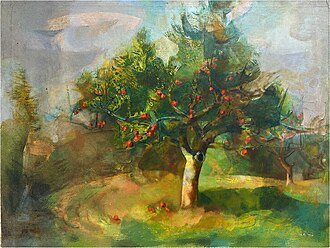
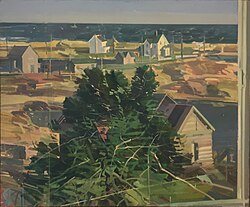
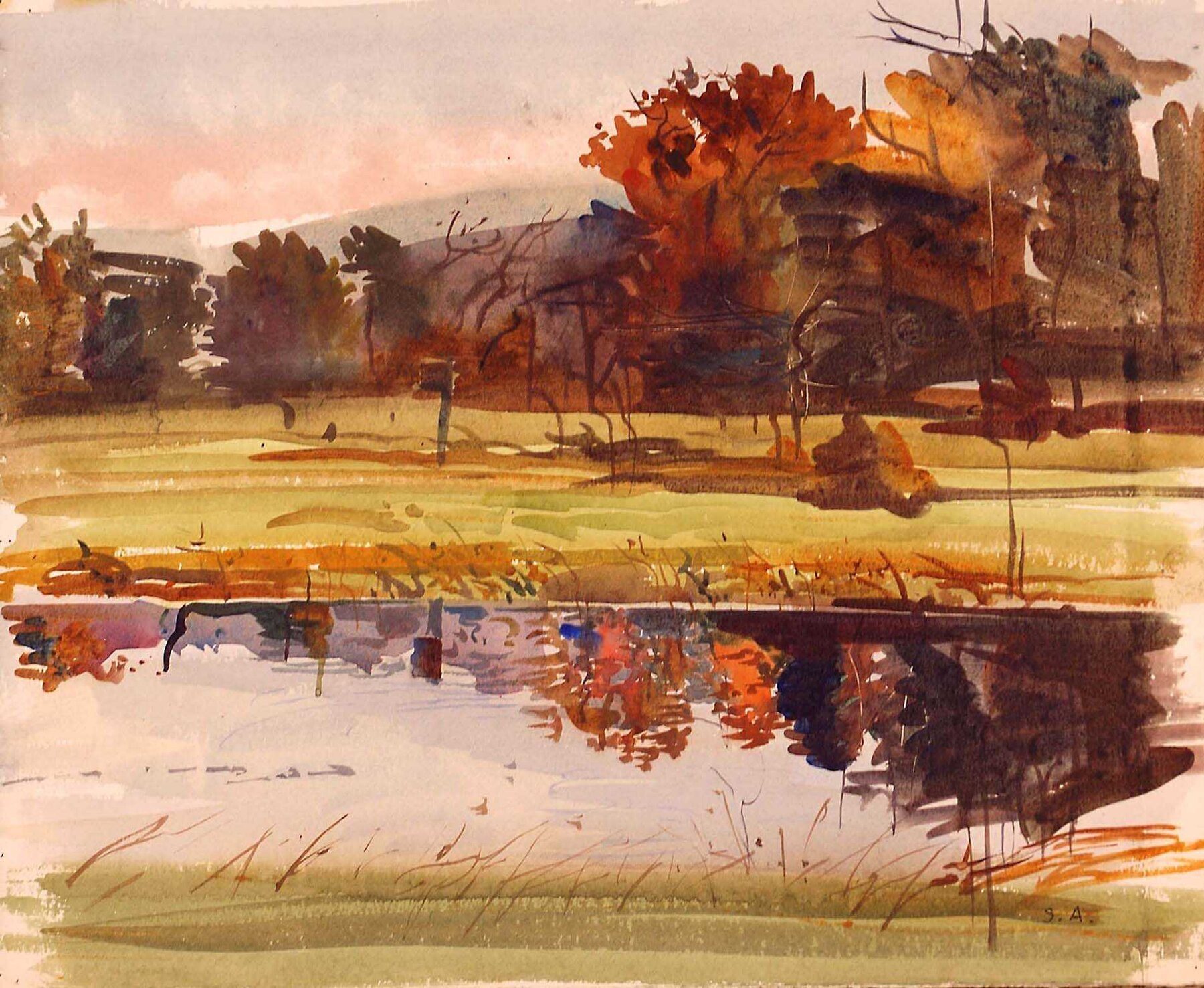
"An artist friend once told me that there are two kinds of artists, the eyeballers and the cerebrals," Sperry Andrews once said. "I'm an eyeballer, I'd say. I'm inspired by things I see."
That short description explains a great deal about his work. He was primarily a plein air landscape painter, and he worked across a remarkable range of media: oil, watercolor, pastel, gouache, scratchboard, etching, graphite and charcoal. Whatever the medium, the starting point was the same. He looked, and he painted what was in front of him.
Finished in the field
Plenty of landscape painters make quick studies outdoors and complete the real painting in the studio. Andrews did not. In 1983, Charles Ferguson, then director of the New Britain Museum of American Art, put it this way:
Sperry Andrews paints year round out-of-doors… His paintings are completed on the spot, not the usual 'sketch from the field and finish it in the studio' scheme... That is undoubtedly why Sperry Andrews' paintings and drawings have such freshness and harmony of light, color and line.
Ferguson also noted "traces of Cubism and the Oriental" in the work, blended into something "uniquely and truly his own." Those Cubist traces go back to the late 1940s, when Andrews studied at the Art Students League on the GI Bill and the modernist Morris Kantor introduced him to Cubist structural composition. He later moved toward realism, but the underlying architecture of his pictures never quite left.
To keep working outdoors through long days and overnight trips, he used a modified Willys Jeep as a mobile studio.
The farm as a lifelong subject
In 1957, Sperry and Doris Andrews purchased the Julian Alden Weir farmhouse on the border of Wilton and Ridgefield, Connecticut. Weir was one of the important figures of American Impressionism, and Andrews had first come to the property through his friendship with the sculptor Mahonri Young, Weir's son-in-law, painting the surroundings there before the farm became his own.
Once it was his home, the farm became one of his primary subjects. The first volume of Beauty to Embrace in an Afternoon is organized the way you would walk the property: the House, the Yard, the Farm, the Studios, the Pond, the Preserve, Cora's, the Flowers, and Winter. Seeing them together, you notice how often he returned to the same view under different light, the same way he described Monet returning "again and again to the same location on successive days."
Saving the place he painted
The farm was not only a subject. It was something he and Doris worked to protect. To prevent commercial real estate development, the couple worked with local preservation and environmental groups, and in 1990 the United States Congress designated the property the Weir Farm National Historic Site, later a National Historical Park. Andrews lived and kept his studio there until his death in 2005.
Today the park's own museum collection includes his work, and his paintings of the grounds are a record of the place as an artist saw it, day after day, for almost half a century.
Browse the full Weir Farm gallery, or use the map on any page to see the farm's work by location.