Stories
Being with your father was a continuously wonderful experience and one from which I always gain so much insight into another way of looking at everything. Thank God for true individuals.
Taking a walk with Sperry was a truly stimulating experience. It was a look into a world that he could articulate so clearly, most clearly, with a paintbrush. He opened up a trip that I had no idea I was in for, totally unexpected that he would help me to see what I had seen often, but not really seen. Sperry looked way beyond the surface, which took more energy than the average person could begin to muster up. Of course, he was a painter. Light texture, surface color shape, that was his world. All of a sudden, he made you aware of a whole new set of dimensions that could have been so easily missed. The obvious didn't escape him. For him, it was right there all the time. Sperry was much more discerning than anyone might suspect, which was part of the intrigue of getting to know him
- R. Faesy, personal communication, August 9, 2005
- R. Faesy, personal communication, August 9, 2005
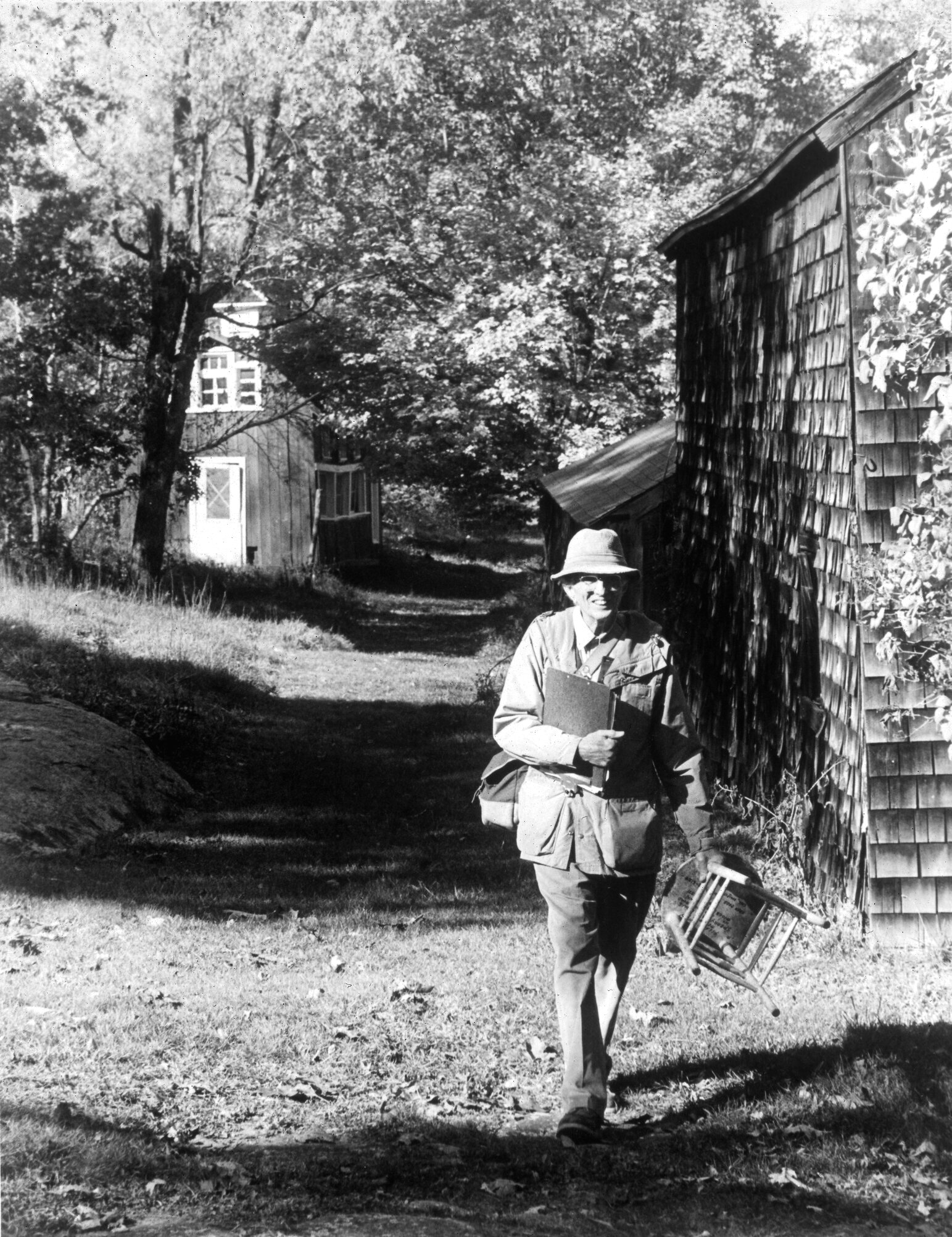
As my interest in painting and drawing grew, Sperry was encouraging and helpful in all sorts of ways. He taught me how to stretch a canvas, he advised me on materials, he would comment on whatever I was doing and always he set a fine example of how an artist lives and works. Sperry and I would discuss at length painting and the painters we both admired, making pilgrimages to the Hudson River to visit F.W. Church's home. Sperry was certainly eccentric, which was part of his considerable charm. He was a hilarious storyteller and the best of companions.
- J. Hubbard, personal communication, August 2005.
- J. Hubbard, personal communication, August 2005.
On a fine summer day in the early 1970s, Sperry Andrews, who had painted at this spot for many years, invited me to come along and paint with him. This was truly an honor, a golden opportunity to paint with one of the great artists of the island. An inspiring teacher, Sperry Andrews shared so many valuable thoughts and ideas about painting. With great humor and a love of life, he let me know his feelings about his work as an artist. We had fun that day admiring the beauty all around us and painting it.
- K. Knapp, Block Island, 2007.
- K. Knapp, Block Island, 2007.
His sensitive drawings, forceful gouaches and monotypes evoke his Art Students League experience and lonely sojourn during military service in the barrens of Iceland, which awakened a sense of awe at the majesty of nature for him. His post-war explorations of Cézanne's example and Cubism are refined and miracles and not very well known. And finally, his three-plus decades of mature work at Weir Farm and in the New England landscape he knew and loved so well. Everywhere one looked, there were beautiful oils, watercolors and drawings by Mr. Andrews on the walls, easels, in deep stacks, racks and piles against the walls and on every flat surface. Here in layer upon layer was an artist’s fine and full life.
I spent an ecstatic afternoon carefully going through stacks of stretched and unstretched oils, watercolors, drawings, scratch boards, pastels, monotypes and even a few etchings. I was amazed at the lively vitality of his drawings, the often surgical precision with which he observed and rendered man-made and natural form alike. His watercolors were a revelation with their fluid execution and ability to capture fleeting light and color in the ever-changing landscape. His oils confirmed his masterful draftsmanship as well, his sense of composition and unique color, but something more. The early works showed [his] youthful intellectual and artistic ferment and aspects of his inner emotional life. The full measure of his vast body of work slowly revealed itself in all its subjects, media, styles and moods.
- M. Chabot, eulogy, 2005
I spent an ecstatic afternoon carefully going through stacks of stretched and unstretched oils, watercolors, drawings, scratch boards, pastels, monotypes and even a few etchings. I was amazed at the lively vitality of his drawings, the often surgical precision with which he observed and rendered man-made and natural form alike. His watercolors were a revelation with their fluid execution and ability to capture fleeting light and color in the ever-changing landscape. His oils confirmed his masterful draftsmanship as well, his sense of composition and unique color, but something more. The early works showed [his] youthful intellectual and artistic ferment and aspects of his inner emotional life. The full measure of his vast body of work slowly revealed itself in all its subjects, media, styles and moods.
- M. Chabot, eulogy, 2005
To see Sperry paint is what being an artist is all about. He had found something beautiful that had captured his attention. His focus was complete. He was totally in the beauty of the moment. I knew then that I had the privilege of being in the presence of a real artist.
Four or five artists would get together in Sperry’s studio to draw a model. I think we simply called up and figured out what was going on on a particular day. No set time, nothing formal, artists simply wandered in and out all day. In the winter the model sat close to the stove. She was absolutely bright red on one side and icy blue on the other. We kept rotating her in a vain attempt to keep her warm. We finally resorted to quick sketches so that she could move. I remember we were all bundled up in layers of sweaters and jackets but we were so intent on our drawings that we didn’t let the cold bother us
The dining room was immense. I remember the antler chandeliers. I remember both Doris and Sperry telling stories about the different pieces of furniture in the room. But mostly I remember the vibrancy of the people. The table was filled with artists and writers and actors. Young people and old people, wonderful giving people who had interesting lives and were willing to share their stories. All of us had a real love for Doris and Sperry. The evenings were special. I remember once it was about two o’clock in the morning and no one had budged from the table. Not because there was a lot of alcohol but because the conversation was so full and rich no one wanted to leave.
Sperry showed at the Century Club in New York. After the opening of the exhibition, we walked with him to Grand Central Station. He was all ready to take the train home to Connecticut. He had paintings under his arm. He stood apart among all of the harried New York commuters. He knew where he was going—home. Home to paint and home to Doris. He was dignified, genuine, loving and above all an artist. They both were. They had a great love for their family and friends and that love was returned to them by those of us who were fortunate enough to be called friends
- C. Gibbons, private communication, August 2005
Four or five artists would get together in Sperry’s studio to draw a model. I think we simply called up and figured out what was going on on a particular day. No set time, nothing formal, artists simply wandered in and out all day. In the winter the model sat close to the stove. She was absolutely bright red on one side and icy blue on the other. We kept rotating her in a vain attempt to keep her warm. We finally resorted to quick sketches so that she could move. I remember we were all bundled up in layers of sweaters and jackets but we were so intent on our drawings that we didn’t let the cold bother us
The dining room was immense. I remember the antler chandeliers. I remember both Doris and Sperry telling stories about the different pieces of furniture in the room. But mostly I remember the vibrancy of the people. The table was filled with artists and writers and actors. Young people and old people, wonderful giving people who had interesting lives and were willing to share their stories. All of us had a real love for Doris and Sperry. The evenings were special. I remember once it was about two o’clock in the morning and no one had budged from the table. Not because there was a lot of alcohol but because the conversation was so full and rich no one wanted to leave.
Sperry showed at the Century Club in New York. After the opening of the exhibition, we walked with him to Grand Central Station. He was all ready to take the train home to Connecticut. He had paintings under his arm. He stood apart among all of the harried New York commuters. He knew where he was going—home. Home to paint and home to Doris. He was dignified, genuine, loving and above all an artist. They both were. They had a great love for their family and friends and that love was returned to them by those of us who were fortunate enough to be called friends
- C. Gibbons, private communication, August 2005